
BITTER NOTES
A prenatal palate training log.

This post was inspired by this meme:
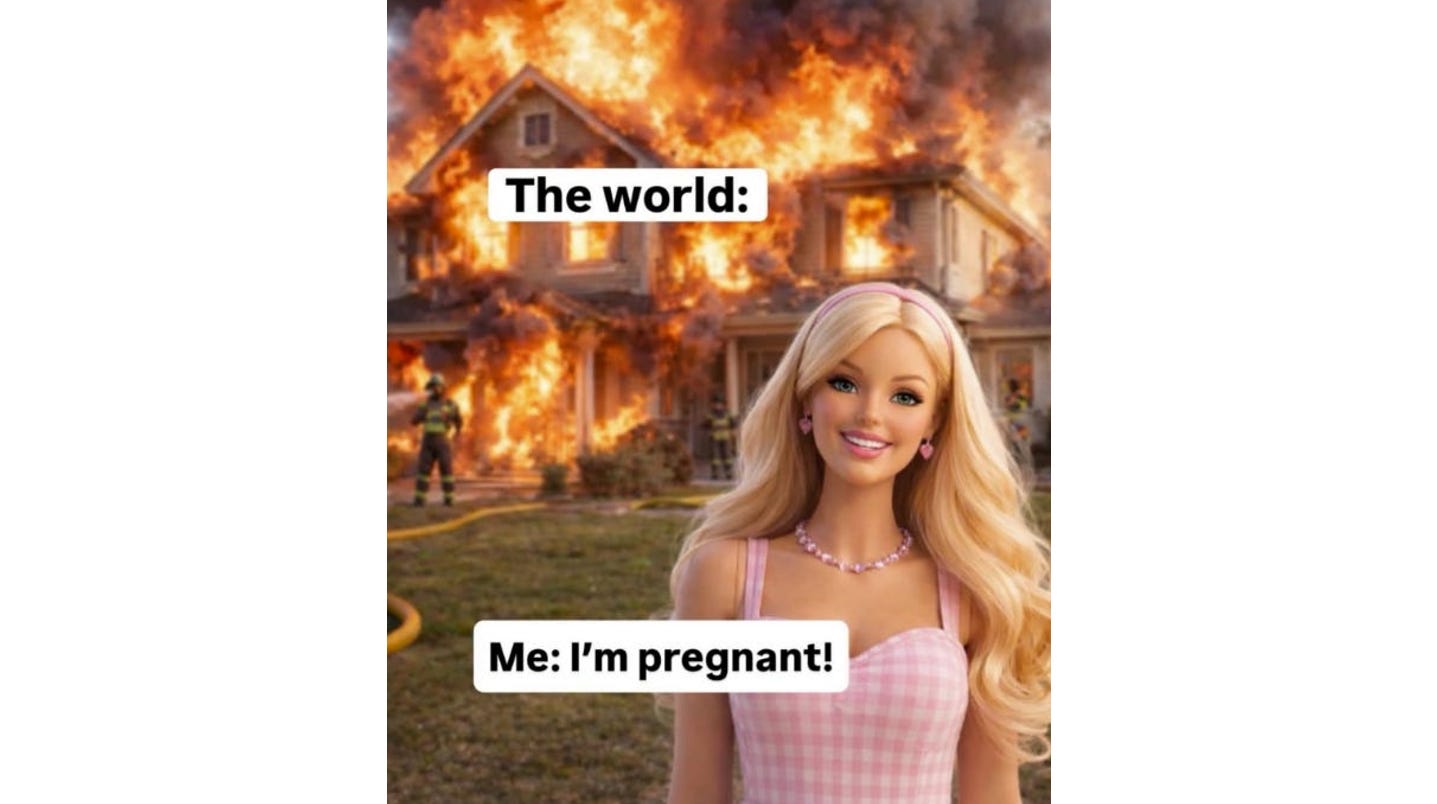
Having a baby right now feels like an irrational, slighty defiant act of luxurious optimism.
Naturally, despite all my attempts to dissociate from what’s going on in the world, I’m still anxious and concerned. It’s why I’ve started Prenatal Palate Training™.
A lot of people think eating during pregnancy is just about nutrition, but recent studies suggest that this thinking is outdated. Prenatal Palate Training™ is about giving a future person a head start: exposing a foetus to flavour complexity, developing their taste, and introducing cultural capital before they even enter this world.
Some parents read or play classical music to their unborn children. I’m tallying 30 different fruits and vegetables a week in the name of our shared microbiome while playing Talking Heads on vinyl.
First trimester: Survived on whole pineapples flown in from Costa Rica and micro-bakery croissants.
Second trimester: All about corrective education: an intensively seasonal, local flavour-exposure curriculum.
Third trimester: Advanced preserves and fermentation. Yesterday I introduced anchovy-stuffed olives. Tomorrow I move further into unchartered challenger territory.
The world may be unstable but within the perimeter of my kitchen, hope persists. The baby will emerge asking for fennel and recognising the protest in Fela Kuti. No deposit. No safety net. Just a palate, a sensibility, and the ability to sit with bitter notes: resilience.
Prenatal Palate Training Log
Day 131
Exposure: Radicchio
Cost: £5 a head
Rationale: Character-building
Conditions: Rain and mild flooding
Status: Hope persists
Day 175
Exposure: Quality Palestinian Olive Oil
Cost: £25/L
Rationale: Civilization may collapse but my ethics and standards cannot
Conditions: Geopolitically fraught and tense
Status: Angry but in control
Day 236
Exposure: Extra Mature Kimchi
Cost: £7.50, 250g
Rationale: Preparing the child for complexity
Conditions: World War III
Status: Brave externally. Internally… acid reflux.
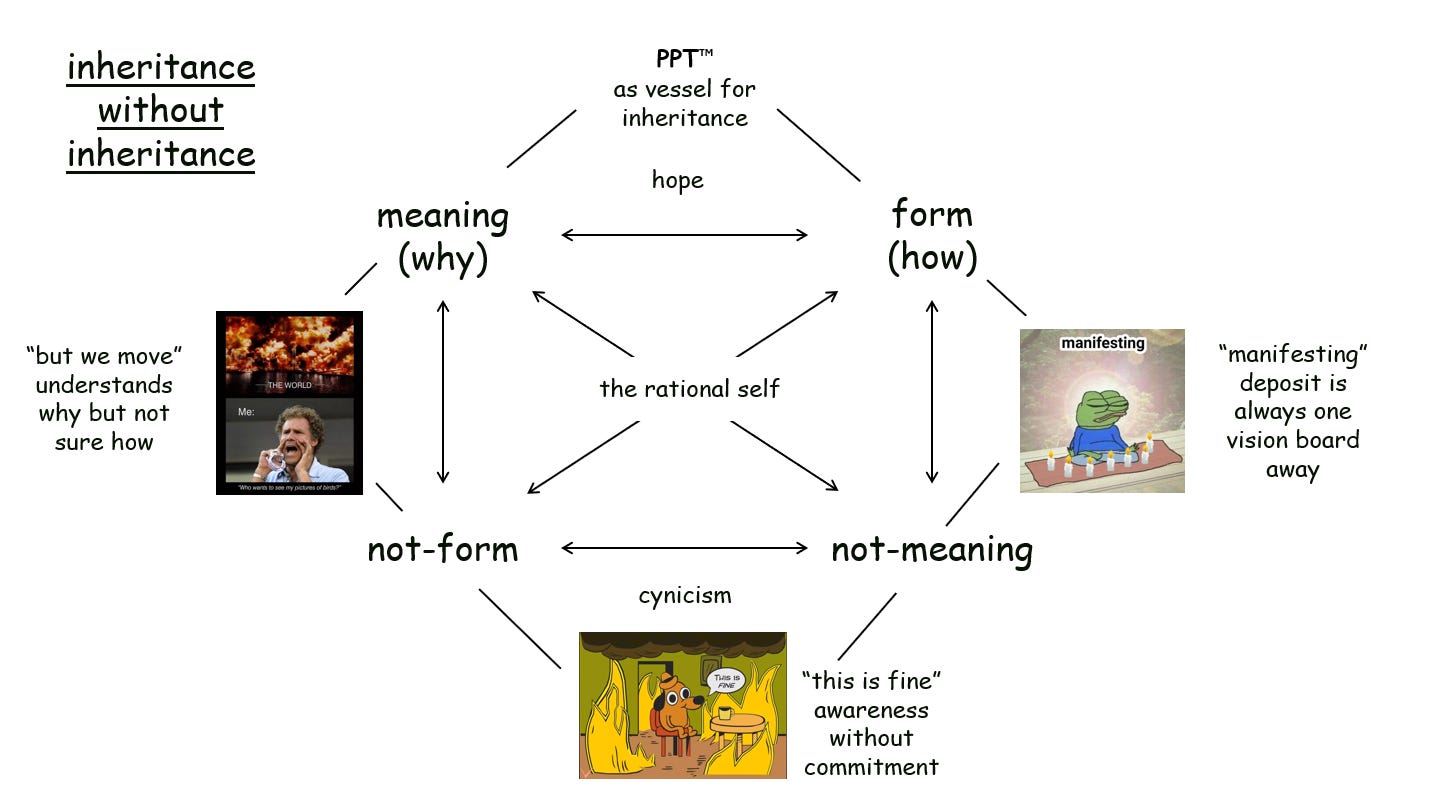
As a subversive millennial, I was trained in irony. It started as a defense mechanism against conformity and evolved, thanks to the internet, into a way of life where everything is viewed through layers of detachment, sarcasm, and self-reference. Sincerity felt naive. Hope was kind of embarassing. The intelligent response to an unstable world was to acknowledge the instability with a meme and continue whatever you were doing.
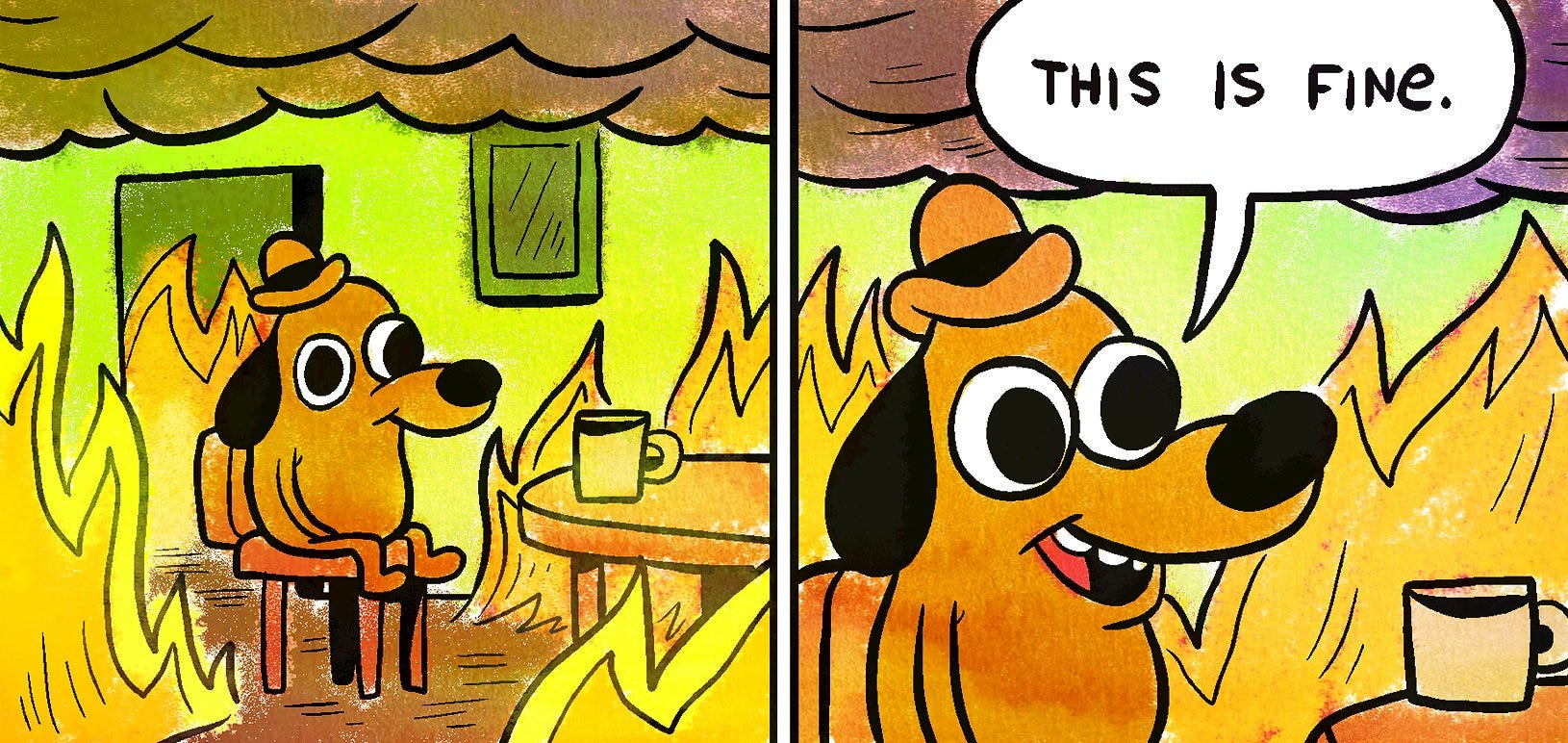
The dog sits in the burning room: this is fine. It works because it’s accurate and versatile, not just as satire but as self-portrait too. Full awareness of the situation. Complete continuation of daily life. It’s not denial, but something more interesting than that; like the decision to keep going anyway. "Keep Calm and Carry On". Real life dressed up as a joke.
This ironic era also produced the debunk: a chronically online intellectual reflex. It’s the move where you take something that looks sincere and explain what it’s really all about. Applied to culture, it can be eye-opening. When applied to human emotion, it tends to be both correct (technically) and completely wrong. It explains the form (the what/how) but misses the meaning (the why). It also keeps the camera pointed outward. (You never have to reckon with hope if you can reduce it to performance).
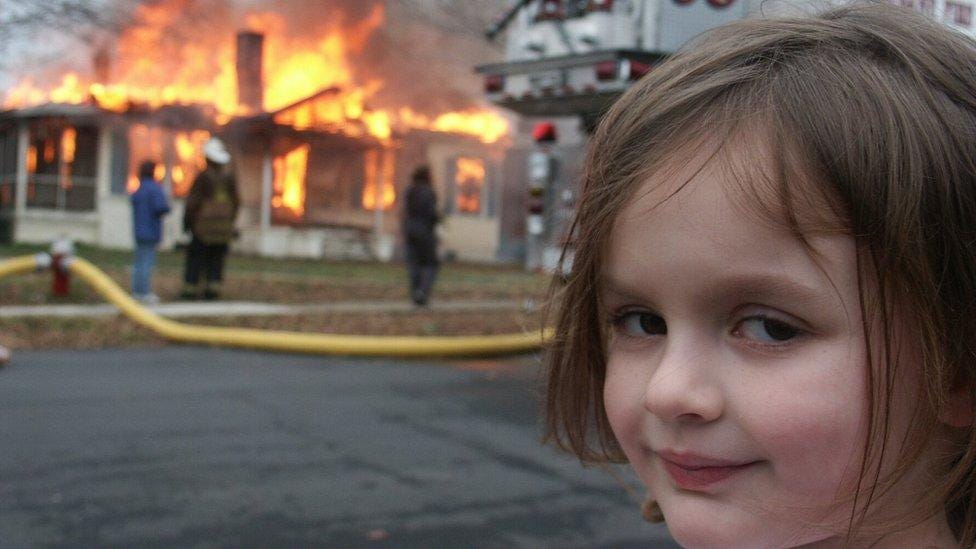
The world being in the condition it is in is, if nothing else, excellent company. When the outside is loud enough, it provides very good cover for a life that is also (in its own ways) somewhat mid-renegotiation. The logs say “flooding” and “World War III” but the conditions field has always been doing more than one job. Chaos is easier to mock when it’s collective. Because when it belongs to everyone, it belongs to nobody in particular. A person can keep her situation under global and keep moving.
There's always a good list of reasons not to have kids, or to wait. Things might be complicated in ways that are difficult to explain at a dinner party. It’s much easier to file them under “conditions: geopolitically fraught.” This internal monologue and/or external unsolicited advice isn’t malicious. It’s often loving. In its own way, it’s asking whether you have thought this through.
You have. And that’s precisely the problem.
The rational self is very good at conditions. It can list them fluently: my floor is made of glass, the deposit will not materialise. It’s not wrong about any of this. It’s simply applying common sense to a decision that has already decided it won’t be governed by it. Common sense will keep you stuck in the middle indefinitely: intention is there, but action is deferred, and the conditions perpetually never right.
The bet is placed or the bet is deferred.
The people who don’t think it through are probably sleeping a lot better. The people who do (those who have absorbed every reasonable objection, weighed every unfavourable condition, sat with the complexity and still decide to go for it), tend to be the ones tallying vegetables, filling in status reports, checking in on hope.
The reality of being human is that everyone has a story to tell about a thing they did that went against common sense and/or advice. Although it wasn’t rational, it wasn’t necessarily wrong. It was hopeful. Probably meaningful.
What I know about control is that the need for it is inversely proportional to how much you actually have. The Prenatal Palate Training™ curriculum did not emerge from a position of everything being fine. It emerged from a position of very little being fine within the framework of large systems (personal, political, planetary) behaving in ways that nobody planned for. In response, the brain does what it does: finds the smallest possible unit of order and meaning and defends it with rigour.
Hence the log. The rationale. The careful accounting of biodiversity and cost against conditions. A person who actually had everything under control would not be tallying 30 different fruits and vegetables a week. She would be resting.
Here’s where my debunking reflex comes in. Right on cue. You guessed it. It’s Cultural Capital.
I must start by admitting that the vinyl, olive oil, carefully sourced vegetables and curated palate are all signals. They’re distinctions that carry tremendous cultural weight and some cost. Pierre Bourdieu would have something to say about the class encoding embedded in my anchovy-stuffed olives, and he would not be entirely wrong.
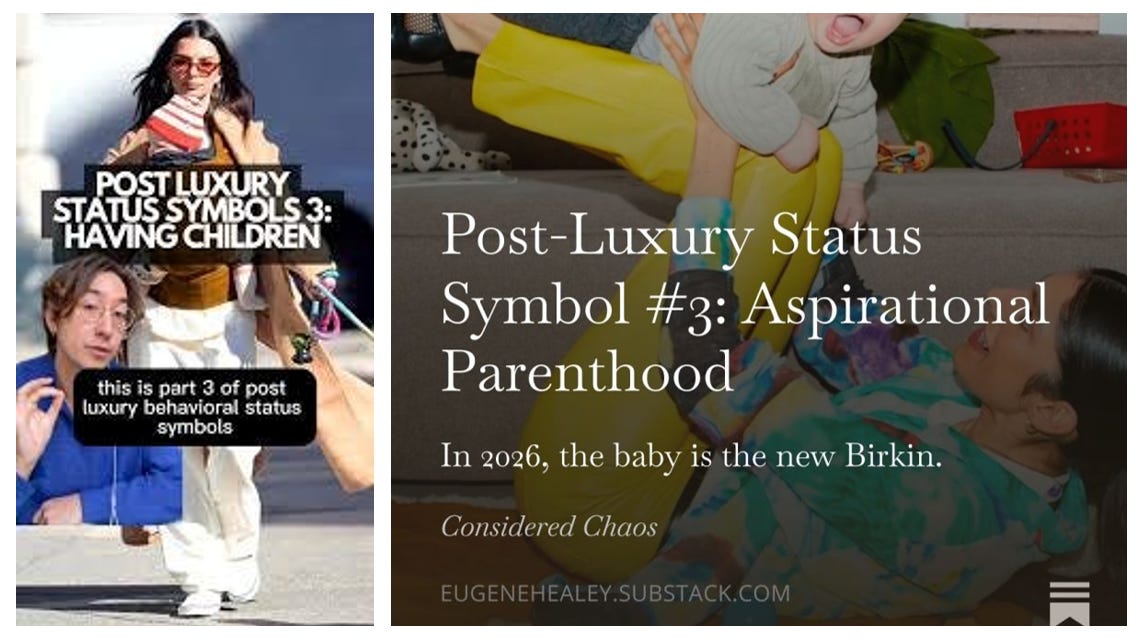
The “parenthood as power move” framing circulating in recent cultural commentary argues that children are becoming a luxury good, functioning as accessories to your personal brand.
While this debunking logic leans on a powerful theoretical framework, it has somewhat misidentified the object. It has made a telling assumption that the person writing the logs has a floor that’s been built by someone else. That the £25 spent on olive oil was an afterthought rather than an a considered decision. That buying radicchio is for someone who is insulated from the rent-equity trap, someone for whom the survival tax has already been solved. Basically, someone who can genuinely afford to perform.
It may not be. It may be the behaviour of someone who has taken a good look at the biological standoff (the impossible arithmetic of the city, the nursery versus the wine bar, the deposit that will not materialise) and placed a bet. Hope, like authenticity, is the currency, the cultural capital, that allows us to climb up the ladder when financial capital is scarce. In this situation, hope is reflected in the realisation that the one thing she can pass on that costs much less than a deposit and means everything (to her) is a palate. A sensibility. A way of moving through the world with taste and resilience and the ability to sit with bitter notes without flinching.
That’s inheritance without inheritance. Cultural capital accumulated not from a position of inherited privilege but from a position of scarcity, transmitted not through property or invisible safety nets but through flavour. Through music. Through the deliberate, and ridiculous act of introducing a foetus to complexity before it has even arrived.
The cultural capital I speak of is hope. That’s what’s being cultivated and passed on. It’s the belief that the future is worth preparing someone for, that bitterness is worth learning to sit with, that complexity acquired early enough becomes a form of resilience. The olive oil is not the point. What the olive oil carries is the point.
The form and the meaning are not the same thing. From the outside, PPT™ looks like control: the curriculum, the logs, the trademark. The debunking system reads the form and stops there. But the form is just the vessel. The meaning is the inheritance. And inheritance, unlike status, is not oriented towards the present. It’s placed in a direction that the audience/interpreter can’t see, toward a future that hasn’t arrived yet, for a person who doesn’t exist yet.
You can’t actually perform for an audience that isn’t born. By nature, the long bet is the least legible thing you can actually do. Which is why the people that are most likely to make it are not the ones with the most to signal, but the ones with the most to prove (to themselves mostly, in the kitchen, with a log and a rationale).
Underneath the performance of the curriculum is a genuine argument. An act of faith and excitement dressed safely as ridicule. Every puntarelle introduced to an amniotic sac is not a sign of delusion. It’s evidence of a position taken, in full knowledge of current conditions, both the ones in the news and the ones closer to home.
A child is the longest bet most of us will ever make. It says that I think there will be a future. I think it will be worth inhabiting. I am willing to stake something irreversible on that belief. Not because the timing is right. Nor because anyone looking at the situation from the outside would call it the obvious move. But because hope is not a reward for favourable conditions. It’s something you practice in their absence.
The ironic stance served a great purpose. It was pretty honest about the gap between the way things were supposed to be and the way they actually turned out. But it became its own kind of evasion. A way of never being wrong because you were never fully bothered or committed. A way of never being exposed because everything was always meant in jest. A way to perform intelligence and mask fear.
Post-ironic hope is not the abandonment of that. It’s what happens when a person has read the room, sent the meme, laughed at the joke, understood that the joke is partially on herself, and then (knowing full well how it looks), bought the radicchio anyway. Not because the conditions are right. Because she has decided that meaning something is worth the risk of being seen to mean it.
Obviously the foetus doesn’t know about any of this. It’s being introduced, incrementally, to the complexity of the world through the medium of flavour. Bitter notes. Fermented things. The protest in a bass line.
Eventually though, it will arrive into whatever the world has become, with a palate shaped by the past few months and the safe perimeter of my kitchen. A place where, thankfully, something always seems to feel possible.
Status: Hope persists.
Cost: Whatever it costs.
Conditions: You know the conditions.
👏👏👏
Very good read, thank you