
HOT MUM SUMMER
Bounce-back culture 2.0, tree-shaped algorithms, and the fight to become someone new.

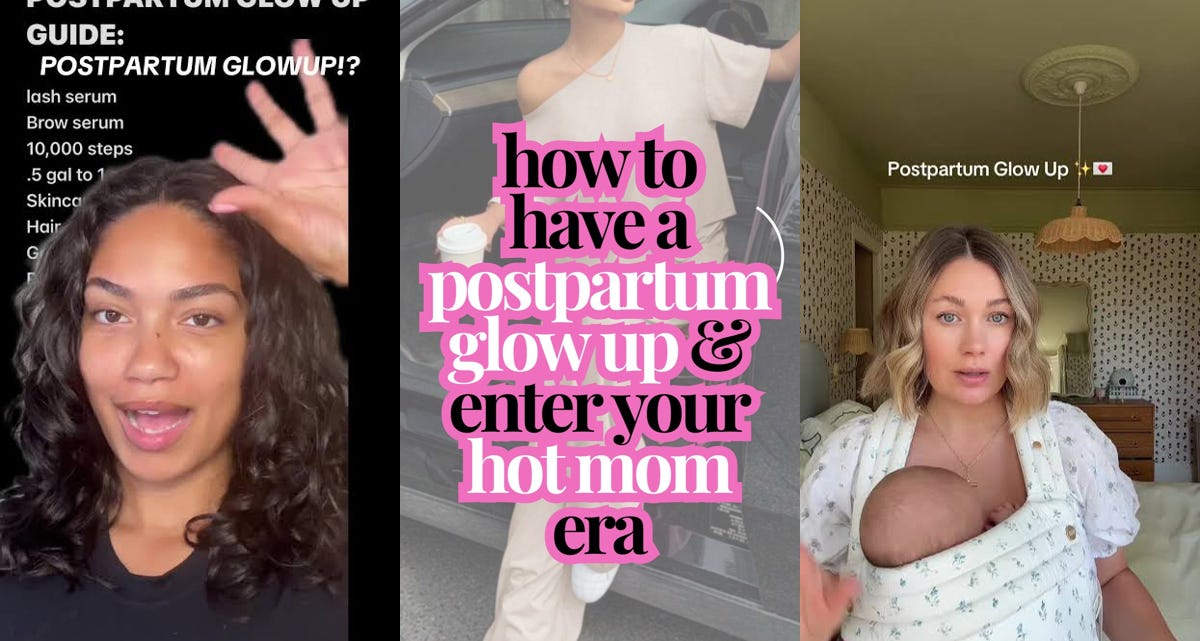
Postpartum Glow Up Guide for New Mums [Stamina Level: Insanity].
Discover effective tips for your postpartum journey! Transform your self-care routine and embrace your beauty after childbirth. #postpartumglowup #glowupguide
Have a baby.
Stack your tasks while baby sleeps: 20min Youtube workout or squats during contact naps or baby carrier pilates.
10,000 steps per day (3-5 miles).
Only eat nutritionally balanced, filling meals you can prepare and eat with one hand while baby sleeps.
Sleep while baby sleeps.
Skin: Brow & lash serum, ice roller in the morning, dry brushing at night.
Etc.
Losing your sense of self postpartum (often called identity grief) is an incredibly common experience for women. It’s something I’ve been curious about and have kept close watch on as I move through the fourth trimester.
From an identity perspective, I feel like myself. Just evolved. I’ve experienced a tremendous amount of change, trauma, and pure joy in a very short space of time. It’s overwhelming. I’ve learned that I can be a mother too.
What’s upset me most, oddly, is something much smaller: the way my body looks right now, and the fact that I can’t wear my clothes the way I’d planned to yet. This is where the grief actually lives. Not in the big existential questions, but in my wardrobe.
I’ve come to think the clothes aren’t really about clothes. They’re one of the few identity signals I could always control. A way of saying this is who I am on any given day. Postpartum, my body isn’t following my intentions on any predictable timeline, and when a tool I’ve always used to express myself stops cooperating, it gets misfiled as I don’t recognise myself, when it’s closer to I don’t have my usual tools right now.
And into that gap walks a new signal: the most toxic form of bounce-back culture I’ve witnessed yet. The old version (where you aim to erase the pregnancy and get your body back) has been replaced by a new one: “Project MILF,” “Hot Mom Summer”, the “MILF Era,” or “MILF Mode.”
Historically an external, male-gaze category, the acronym has been linguistically reclaimed by women themselves as a personal goal, used to signal a refusal to be desexualised or flattened by motherhood. But this pivot away from the traditional, soft “stay-at-home mother” aesthetic simply exchanges one narrow box (the invisible mother) for another: a hyper-curated, digitally performed motherhood rooted entirely in optimisation.
It’s optimisation dressed up as female empowerment. Not just recovering, but coming back better than before. Making up for lost time. It’s worse than the old script because it masquerades as self-love, which makes it harder to catch. But it’s the same restrictive impulse in a girlboss outfit. Still directed towards social approval and billed as tiresome progress.
What both versions of this script share is an assumption I didn’t clock until I tried to name it: that the self is static. Something with a fixed prior state, a “before” that you either return to or improve on, but never actually move past. Bounce back, glow up, optimise… it’s all the same instruction dressed differently: get back to a version of you that already existed. The interest isn’t in who this version of me actually is now, but how close I am to a photo taken before any of this happened.
However, to borrow from Deleuze, identity isn't a fixed state of being. It is a continuous process of becoming. It is a self that is constantly in motion, never arriving at a finished, permanent template.
This optimisation culture promises a false version of growth based on being-more. More toned, more productive, a hyper-efficient upgrade of your past, static self. But it’s a trap because it still assumes the original, pre-baby template is the only valid destination. True postpartum growth is becoming-other. It is an expansion into something genuinely new that the old categories cannot hold. Motherhood hasn't made me a more optimised version of my past self; it has folded entirely new dimensions into my existence. I am genuinely different, not failing to hold still.
To be less vain about it, though, the clothes aren't even the deepest example. A bigger part of my identity is cooking. Slow cooking. No recipes. Grandma style, the kind that comes from instinct and time. The kind that isn’t legible on instagram. It's one of the most tangible ways I can express who I am and what I’ve experienced. Hours spent building something from patience and feel rather than buying it or performing it. With a baby, I can just about manage snacks all day, if I'm lucky.
That loss sits differently to the wardrobe one. It's not about how I'm perceived. It's a skill and a rhythm I built over years, temporarily out of reach, and it makes the identity question less about vanity and more about which parts of a self are actually sustained by having the time and space to practise them.
Bounce back, come back better, make up for lost time, it's all sold on urgency, as if the goal is speed. But getting in shape takes months of consistent, unglamorous repetition, the same currency as the stew. It was never instant, even before a baby existed to blame. So the culture demands urgency while quietly requiring the one thing it never mentions: time, uninterrupted, which is precisely what I don't have right now. That's the real reason the wardrobe grief and the kitchen grief are the same grief underneath. Both are about a life that no longer has the hours it takes to build anything slowly, whether that's a stew or a stomach.
The cruelest part of this urgency is how it pollutes the time I do have. I have a tremendous amount of time to spend with my child. Fluid, fleeting moments that are constantly changing, moments I know I should be cherishing slowly. But the ambient pressure to return to normal, to hurry up and resolve the transition, makes that slow presence incredibly difficult to hold. The culture demands that I rush through the very experience that requires me to slow down.
It's made me think harder about identity as a form of self. How much of it is built from the things we do, buy, wear, and fill our time with, and how easily we conflate that with the self underneath it. Cooking without a recipe and choosing an outfit both count as identity, but they're not the same kind. One is purchasable and performable. The other is a practised, private competence that doesn't need an audience, only time. Both are creative and expressive. But there's a real difference between identity expressed through what can be bought or seen, and identity located in things that need no props at all, like judgment, humour, feeling, how you treat people, or what you notice. Both layers make up the self.
The wardrobe grief and the kitchen grief are unsettling for different reasons. One reveals how much weight I quietly placed on a fragile, expressible layer. The other reveals how much of the deeper layer depends on something as unglamorous as having a spare afternoon.
Then I open my phone, and the algorithm has decided I am a woman who only wants baby content. My identity, flattened into a single feed. And I can’t participate by performing any version of motherhood (tradwife or MILF) because I simply don’t have the time to cook or exercise. And I can't help think that surely this is leaving money on the table? Surely I'm not only worth marketing baby carriers to?
The problem is that the algorithm operates on tree-like thinking. It looks for a single, dominant taproot (in this case, “new mother”) and assumes that every single branch, leaf, and interest of my life must sprout from that one vertical trunk. If I want to cook, it must be a baby-friendly pureé. If I want to read, it must be a parenting manual. It treats a major life transition as a total system reboot, erasing the rest of the landscape.
But a whole person is rhizomatic. We don’t grow like trees… we grow like grass or ginger roots, spreading sideways, non-hierarchically, sending out shoots in every direction at once. My identity as a professional, a cook, a person with niche taste in clothes, and a new mother are all connected horizontally, underground. They intersect and feed into one another with no single defining root.
The algorithm is completely the wrong shape for how a human being actually exists because it cannot track a horizontal, slow-burning self. It values legibility, the instant click, the fast vertical spike of transactional interaction. It can measure a microsecond purchase of a baby carrier, but it has no syntax for a four-hour simmer or months of unglamorous repetition. It isn’t a real mirror. It’s an optimised one, for engagement, not for me.
And it makes the same mistake as the bounce-back script, just from the other direction. Bounce-back culture assumes I’m trying to get back to a better “before.” The algorithm assumes I’ve arrived at a fixed “after,” a permanent new-mother state, and stops updating. Neither one can hold a self that’s still moving. A self that is becoming.
This isn’t hyper-personalisation, it’s a shortcut that looks like personalisation. Brands and platforms that treat major life transitions (new parent, new job, divorce, bereavement, retirement) as the only relevant variable are optimising for short-term engagement at the cost of long-term trust. They’re missing the far bigger opportunity of a person whose identity is expanding, not shrinking, even if her bandwidth for it has temporarily collapsed to snacks and survival.
Bounce-back culture 2.0, Project MILF, "come back better", postpartum "glow-ups", succeeds commercially because it borrows the vocabulary of empowerment while selling the same anxiety as before. Any brand operating in this space should ask whether it's selling recovery or selling inadequacy with better branding. The companies that will earn durable loyalty here are the ones that resist the urge to monetise the gap between how a woman feels and how she's "supposed" to look, and that recognise identity loss isn't only about appearance. It's also about the quieter competencies, like a slow-cooked meal with no recipe, that get crowded out by a schedule that isn't hers to control right now.
People often grieve a symbol of identity, like clothes, body, or routine, not the actual self. Products and services that address the proxy directly, with honesty about what it represents rather than pretending to fix the underlying feeling, build more trust than those promising total transformation. A well-made piece of postpartum clothing that fits now solves a real problem. A campaign promising to help her “get her body back” solves nothing and reinforces the wound. The same logic applies further out from fashion: a service, a meal kit, a moment of covered childcare that gives someone back an hour to cook the way they used to is solving the actual problem, not a marketing-shaped version of it.
My instinct is the sharpest business insight here. A platform that reduces me to one life-stage category isn’t just alienating me, it’s under-monetising me. I haven’t stopped being a professional, a cook, a person with niche interests and old hobbies. My algorithm has been optimised for the loudest, most recent signal instead of the fuller picture underneath it. Systems built to detect the horizontal expansion of identity, not just the rigid confirmation of a single label, will always outperform ones that lock users into narrowing feedback loops, both ethically and commercially.